What if that faint, fishy smell in your laundry isn’t a cleaning mishap, but the scent of your plastic power points slowly melting behind the wall? You’ve likely felt that sudden jolt of anxiety when a light flickers or your circuit breaker trips for the third time in a week. It’s tempting to ignore these small annoyances, yet these subtle signs of electrical fault at home are often the only warnings you get before a minor glitch turns into a dangerous house fire or a total power failure.
We understand the fear of rising emergency call-out costs and the confusion of navigating complex switchboard issues. This guide is designed to give you peace of mind by showing you exactly how to spot red flags early, protecting your Hunter region property and your family’s safety throughout 2026. You’ll learn how to tell the difference between a simple RCD trip and a serious wiring failure; providing you with a clear 24-hour safety plan and the confidence to know when you need a licensed local expert on the scene.
Key Takeaways
- Learn to identify the subtle signs of electrical fault at home, including peculiar fishy smells and buzzing power points, before they escalate into fire hazards.
- Discover how to distinguish between a minor nuisance trip and a critical safety crisis that requires an ASP Level 2 electrician for grid-side repairs.
- Gain a clear, step-by-step safety protocol to isolate dangerous circuits and protect your Hunter region property during an electrical failure.
- Understand the 2026 safety standards for Newcastle homeowners and why rapid, professional fault finding is essential for long-term peace of mind.
- Master the triage process to decide whether your electrical issue requires immediate 24/7 emergency intervention or scheduled maintenance.
Recognising Early Warning Signs of Electrical Faults at Home
An electrical fault is essentially a breakdown in the intended path of electricity. In standard home electrical systems, current flows through a closed loop of insulated copper wires. When that insulation fails or a connection loosens, the electricity escapes its boundaries. This stray energy generates intense heat, which is why identifying the signs of electrical fault at home is the most effective way to prevent a property fire.
For residents in Newcastle, the risk profile varies significantly by location. If you live in older, established suburbs like The Hill or Cooks Hill, your home may still rely on legacy wiring systems that weren’t designed for the heavy load of 2026 technology. These heritage properties often hide brittle rubber insulation or outdated fuse boxes behind their charming facades. Regardless of your home’s age, our safety mantra remains the same: if you smell it or hear it, you must act immediately. Electrical issues rarely “fix themselves”; they simply wait for a point of total failure.
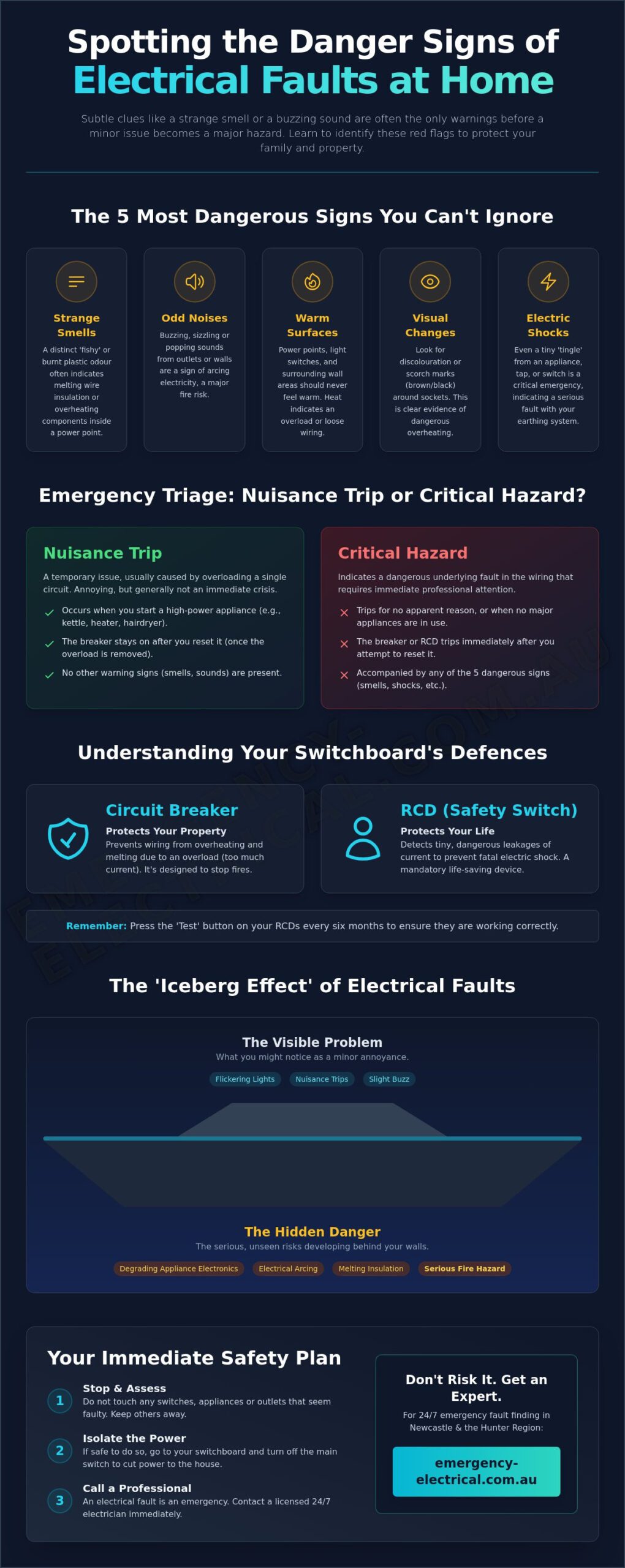
It’s also vital to distinguish between a nuisance trip and a genuine safety hazard. A nuisance trip might occur if you run a high-draw hairdryer and a space heater on the same circuit simultaneously. However, a genuine hazard exists if your switchboard trips for no apparent reason, or if it trips immediately after you try to reset it. These are clear indicators that the system has detected a dangerous leakage of current.
The Role of the Modern Australian Switchboard
Modern switchboards are your home’s first line of defence, but many homeowners confuse circuit breakers with RCDs (Residual Current Devices). While a circuit breaker prevents your wires from melting due to overload, an RCD is a life-saving safety switch designed to prevent electrocution by detecting tiny leakages of current. If your switch is “tripping,” it’s actually doing its job by highlighting a hidden fault before it causes harm. In 2026, the Australian safety standard emphasises using the ‘test’ button on your RCD at least every six months to ensure the internal mechanism hasn’t seized up.
Why ‘Minor’ Issues Often Hide Major Dangers
Electrical faults often demonstrate an ‘iceberg effect’ where the visible symptom is only a fraction of the problem. Small flickers in your LED downlights or slight voltage fluctuations might seem like minor annoyances, but they can silently degrade the sensitive motherboards in your expensive modern appliances. Arcing is a high-power discharge of electricity between two or more conductors, generating intense heat that serves as a primary cause of house fires. Because this happens behind plasterboard walls, you won’t see the sparks until the fire has already taken hold, making early detection through smell and sound your most valuable tool.
The 5 Most Dangerous Signs of Electrical Faults You Can’t Ignore
Identifying signs of electrical fault at home requires you to stay alert to sensory changes in your environment. Your house often communicates distress through smell, sound, and touch before a total system failure occurs. Ignoring these warnings doesn’t just risk your appliances; it puts your family at risk of fire or electrocution. If you notice any of the following five red flags, you should treat the situation as an immediate priority.
- Olfactory cues: A distinct ‘fishy’ or ‘burnt plastic’ smell is a classic indicator of melting wire insulation or overheating plastic components within a socket.
- Auditory warnings: Buzzing, sizzling, or popping sounds coming from behind a wall or inside a power point suggest arcing electricity, which generates extreme heat.
- Tactile signs: Outlets or light switches should never feel warm. If a faceplate is hot to the touch, the internal wiring is likely overloaded or loose.
- Visual indicators: Discolouration, such as brown or black scorch marks around plug sockets, confirms that localized overheating has already occurred.
- Physical shocks: Never dismiss a tiny ‘tingle’ from a tap, toaster, or metal appliance. This is a critical emergency indicating a failure in your home’s earthing system.
To help you stay on top of these risks, you can refer to a comprehensive electrical safety checklist to audit your property. If you’ve experienced even a minor shock, it’s vital to have a professional investigate the source before someone is seriously injured.
Newcastle Coastal Factors: Salt Air and Corrosion
Living in coastal suburbs like Merewether or Bar Beach brings unique challenges to your electrical system. The salt-laden air accelerates terminal corrosion, leading to high-resistance connections that generate heat. In many older Hunter region homes, you might even spot ‘green slime’ (cuprosolvency) on wires, a chemical reaction between moisture, salt, and copper. Because of these harsh conditions, outdoor power points in Newcastle require higher IP (Ingress Protection) ratings to prevent premature failure and dangerous short circuits.
Fault Signs in Storage Hot Water Systems
Your hot water unit is one of the highest energy consumers in your home, making it prone to specific electrical faults. If your circuit breaker trips every time the water starts heating, you likely have electrical leakage in the heating element. A failing thermostat can also cause the system to overheat, putting immense strain on your switchboard. When these issues arise, it’s best to seek professional storage hot water repairs to ensure the unit is safely isolated and restored. If you’re unsure about a strange sound or smell, don’t wait for the power to go out; a quick check by a licensed Newcastle electrician can prevent a costly emergency later.
Emergency Triage: Deciding if Your Electrical Issue is a Safety Crisis
When you encounter signs of electrical fault at home, your first task is triage. You must decide if the situation is an immediate threat to life and property or an issue that requires urgent maintenance within the next business day. For Newcastle residents, an immediate threat includes any scenario where fire is imminent or where the home’s earthing system has failed. Urgent maintenance, by contrast, might involve a single faulty power point that you have already safely isolated at the switchboard. Understanding this distinction prevents unnecessary panic while ensuring you don’t overlook a genuine crisis.
One of the most dangerous yet misunderstood issues is a ‘Neutral Fault.’ This occurs when the connection to the electricity grid’s neutral wire becomes loose or damaged. If you notice your lights getting significantly brighter or dimmer unexpectedly, or if your appliances are behaving erratically across the whole house, this is a major safety crisis. It can lead to high-voltage surges that destroy electronics and pose a severe shock risk. This is not a standard internal wiring issue; it is a fundamental failure of the power supply that requires immediate professional intervention.
When to Call a 24/7 Emergency Electrician
There are specific scenarios where waiting until morning is not an option. If you observe visible smoke or a persistent, acrid burning smell that you cannot trace to a specific appliance, your home’s internal structure may be at risk. You should also call for emergency assistance if you experience a total power loss while your neighbours’ lights remain on. This often indicates a phase failure or a fault at your point of attachment. Finally, any active sparking or ‘arcing’ sounds at the switchboard are critical signs of electrical fault at home that require a rapid response to prevent a house fire. You can find more detailed warning signs of faulty electrical wiring to help you assess the severity of these symptoms.
Identifying Level 2 Grid Connection Faults
In the Hunter Valley, severe storms often cause damage to overhead service lines or private power poles. These are grid-side issues that a standard electrician is not authorised to repair. If you see fallen or sagging lines near your property, or if your whole-house power is flickering rather than just a single room, the fault likely lies at the ‘Point of Attachment’ or within the service fuse. Because these components handle high-voltage current directly from the street mains, only an ASP Level 2 electrician has the accreditation and specialised equipment to safely perform these repairs. Identifying these grid-side faults early ensures you call the right specialist the first time, saving you time and reducing the risk of prolonged power failures.
Safe Response: What to Do Immediately When You Detect a Fault
Once you have identified the signs of electrical fault at home, your reaction time is the deciding factor in preventing property damage. Your priority must shift from observation to isolation. Following a structured safety protocol ensures that you protect your family while preparing the site for professional intervention. If you encounter an active hazard, follow these five steps immediately.
- Step 1: Do not touch. Never attempt to unplug a smoking appliance or touch a power point that is emitting sparks. The risk of arc flash or electrocution is at its highest during an active failure.
- Step 2: Isolate the power. If it is safe to do so, move to your switchboard and turn off the main switch or the specific circuit breaker related to the fault. This cuts the energy source and stops the heat generation.
- Step 3: Protect your electronics. If the fault involves voltage fluctuations, unplug sensitive devices like computers and televisions on other circuits. This prevents high-voltage surges from frying internal components.
- Step 4: Create an exclusion zone. Keep children and pets well away from the affected area. Electrical faults can cause hidden fires behind walls that may not be immediately visible.
- Step 5: Call for help. Contact a licensed emergency electrician in Newcastle to conduct a professional fault-finding assessment.
The Dangers of DIY Fault Finding
It is tempting to try and “diagnose” the issue yourself, but Australian law strictly prohibits unlicensed electrical work for a reason. Beyond the obvious risk of death, performing your own repairs can void your home insurance policy. If a fire occurs later and investigators find evidence of DIY electrical work, your claim will likely be rejected. You must also be aware of ‘stored energy’ in capacitors; even after you have turned off the main power, certain appliances and components can still hold a lethal charge. A ‘resetting’ breaker is a temporary fix, not a solution, and repeatedly forcing a switch back to the ‘on’ position can lead to catastrophic terminal failure.
Preparing for the Electrician’s Arrival
To ensure the fastest possible repair, you can help by clearing a path to your switchboard and the suspected fault area. Our technicians need rapid access to test the circuits and identify the root cause. If you can, note down the exact sequence of events, such as whether the toaster was on when the fishy smell started. This information is invaluable for rapid fault finding. Finally, please secure your pets in a different room or the backyard to allow the sparky to work safely and without distraction. For immediate assistance with any dangerous electrical situation, reach out to our licensed Newcastle electrician team right away.
Expert Fault Finding: Why Newcastle Emergency Electrical is the Local Choice
When you discover the signs of electrical fault at home, you don’t just need a tradie with a toolbox; you need a specialist who understands the unique infrastructure of the Hunter region. We provide a rapid 24/7 response across Newcastle, Maitland, and Port Stephens, ensuring that a dangerous situation is neutralised before it escalates. Our team operates with a strict ‘Safety First’ mantra. We don’t believe in temporary patches that merely delay a crisis; we focus on permanent, high-standard repairs that address the root cause of the failure. This commitment to excellence ensures your property remains compliant and your family stays protected.
Our ASP Level 2 accreditation is a significant advantage for our clients. As we established earlier, many complex faults originate at the point of attachment or involve the service fuse. While standard electricians are legally restricted to working on your internal wiring, our team has the authority to handle grid-side connections. This means we can resolve the entire issue in a single visit, whether the fault is buried deep in your kitchen wall or located out on your private power pole. We also prioritise transparent communication, taking the time to explain the ‘why’ behind every repair so you can make informed decisions about your home’s safety.
Specialised Equipment and Diagnosis
We use advanced diagnostic technology to identify hazards that the naked eye simply cannot see. Thermal imaging is a cornerstone of our fault-finding process, allowing us to detect ‘hidden’ hot spots behind your plasterboard before they ignite. We also utilise insulation resistance testing to find degraded wiring before it reaches the point of arcing. Our technicians possess deep experience with the diverse housing stock of the Hunter. We understand the specific challenges of heritage Newcastle terrace homes, such as antiquated conduit, as well as the high-load demands of modern Lake Macquarie estates.
Peace of Mind for Your Home and Family
Every specialised repair we perform comes with a full compliance certificate, providing you with a legal record that your home meets current Australian safety standards. This documentation is essential for insurance purposes and future property valuations. Our local knowledge of Ausgrid requirements and Hunter region safety regulations ensures that every job is completed to the highest regulatory standard. Don’t leave your safety to chance when dealing with a potential fire hazard. Contact Newcastle Emergency Electrical now for 24/7 support and let our licensed experts restore your peace of mind.
Protect Your Hunter Property Today
Understanding the common signs of electrical fault at home is your first and most vital line of defence against house fires and system failures. Whether you are managing an older property in The Hill or a modern coastal home in Merewether, staying alert to sensory warnings like buzzing sockets or acrid smells can prevent a minor glitch from becoming a safety crisis. Remember that grid-side issues require specialised care; distinguishing between internal wiring faults and Point of Attachment failures ensures you get the right help quickly.
Our team of licensed and insured local specialists is ready to help you navigate these risks with calm professionalism. As ASP Level 2 authorised electricians, we provide a 24/7 rapid response across the Hunter region, including Newcastle, Maitland, and Port Stephens. We don’t just offer temporary fixes; we provide permanent solutions that meet strict 2026 safety standards. Call Newcastle Emergency Electrical now on 0400 000 000 for 24/7 emergency support. Your family’s safety is our priority, and we are here to ensure your home remains a secure sanctuary for years to come.
Frequently Asked Questions
What is the most common sign of an electrical fault in an Australian home?
Tripping circuit breakers or safety switches (RCDs) are the most frequent indicators that something is wrong. This usually happens because the system has detected a current overload or a dangerous leakage to earth. While it can be frustrating, it is often the first of several signs of electrical fault at home that prevents a house fire or a serious electric shock.
Why do my lights flicker when I turn on a high-powered appliance like the kettle?
This typically occurs because the appliance draws a large amount of current, causing a temporary voltage drop on that specific circuit. While common in older Newcastle homes with limited electrical capacity, persistent or severe flickering can indicate loose wiring or an undersized mains cable. You should have a professional check your connections to ensure your switchboard can safely handle the modern load.
Is a buzzing sound from a light switch always dangerous?
Yes, any audible buzzing, sizzling, or popping from a switch or outlet should be treated as a safety hazard. These sounds are caused by arcing, where electricity jumps across a gap in a loose or damaged connection. This process generates intense heat and is a leading cause of electrical fires in residential properties across the Hunter region.
What should I do if I smell burning but can’t see where it’s coming from?
You must immediately turn off the main power at your switchboard and contact an emergency electrician for a professional assessment. A “fishy” or “burnt plastic” smell often indicates that wire insulation is melting inside your walls or ceiling space. Even if you don’t see smoke, the heat could be building up behind plasterboard where it remains invisible to the naked eye.
Can a faulty hot water system cause my whole house to lose power?
It certainly can if the fault causes your main safety switch or main circuit breaker to trip. A grounded heating element or a short-circuited thermostat in your storage hot water unit creates a massive surge that the switchboard must isolate to protect the entire home. If resetting the switch results in an immediate trip, the hot water system is a highly likely culprit.
Why does my safety switch (RCD) keep tripping for no apparent reason?
Nuisance tripping is rarely without a cause; it usually indicates a cumulative earth leakage from multiple appliances or a genuine signs of electrical fault at home. Moisture in outdoor power points or a failing compressor in an old fridge are common triggers. A licensed sparky can use an insulation resistance tester to pinpoint exactly which circuit or appliance is leaking current.
Do I need a Level 2 electrician for a fault at my meter box?
You will need an ASP Level 2 electrician if the fault involves the service fuse, the point of attachment, or the overhead lines coming from the street. Standard electricians can work on internal wiring and individual breakers, but they aren’t authorised to break the seals on the service provider’s equipment or handle the high-voltage incoming mains. Most grid-side issues require this specialised level of accreditation.
How much does an emergency electrical call-out cost in Newcastle?
Emergency call-out fees in the Newcastle and Hunter region vary based on the time of day, the day of the week, and the complexity of the fault finding required. While we don’t provide fixed quotes over the phone without seeing the hazard, we maintain transparent communication regarding our rates for emergency attendance. You should always confirm the call-out fee structure before the technician arrives at your property.