Would you recognise the smell of an electrical fire before the smoke alarm even triggers? For many homeowners in Newcastle, especially those living in beautiful but ageing terraces, the line between a minor quirk and a major emergency is often dangerously thin. Identifying potential electrical safety hazards home owners often overlook is the first step in protecting your property from the risks of outdated wiring or faulty components.
You deserve to feel secure in your own house. This guide helps you manage common dangers to protect your family and property. We’ve put together a clear checklist of what to look for, from outdated ceramic fuses that insurance companies are now flagging in 2026, to the latest AS/NZS 3000 RCD requirements. By the end, you’ll have the peace of mind that comes with knowing exactly when a fault is a true emergency and when your system requires professional attention.
Key Takeaways
- Understand how identifying hidden electrical safety hazards home owners often miss can prevent life-threatening shocks and property damage.
- Learn to recognise the warning signs of overloaded power boards and “piggybacking” adapters that create high-risk fire zones.
- Clarify your maintenance responsibilities for private power poles and overhead lines to keep your property safe and compliant.
- Distinguish between circuit breakers and RCDs to ensure your switchboard provides modern, whole-of-house protection.
- Master the essential steps for safely isolating your power and identifying which electrical faults require an immediate 24/7 emergency response.
What are Electrical Safety Hazards in the Home?
Identifying electrical safety hazards home owners face daily is about more than just avoiding a blown fuse. An electrical hazard is any condition within your property’s system that could lead to fire, shock, or electrocution. These risks often remain invisible, hidden behind plasterboard or inside ceiling cavities, until a component fails or someone suffers an electrical injury. While some issues are slow-burning maintenance tasks, others are immediate threats that require an emergency response. Newcastle Emergency Electrical provides comprehensive safety audits to bridge this gap, helping local families distinguish between a simple repair and a life-threatening fault.
Why Awareness is Your Best Defence
Early detection is your most effective tool against domestic disasters. Most electrical fires don’t happen by accident; they’re the result of ignored warning signs like warm power points or persistent circuit trips. Ignoring these minor faults can lead to devastating financial loss and emotional trauma. Adopting a safety-first mindset means investigating the small things before they escalate. We encourage Newcastle families to treat their electrical system with the same regular scrutiny as their car or their health. A proactive approach ensures that a small spark today doesn’t become a house fire tomorrow.
Common Causes of Domestic Electrical Faults
Several factors contribute to the prevalence of faults in the Hunter region. Suburbs with heritage homes often rely on ageing infrastructure that wasn’t designed for the high-power demands of modern appliances. This strain can cause insulation to degrade and wires to overheat. We also frequently see the dangerous aftermath of DIY “handyman” electrical work. Unlicensed modifications are not only illegal in Australia; they’re a primary cause of house fires.
Environmental factors are equally significant in our local area. Salt air and coastal humidity accelerate the corrosion of external fittings, switchboard components, and service lines. Storm surges and heavy rain can also penetrate outdoor outlets, leading to short circuits. Regular maintenance is essential to combat these unique local challenges and keep your home’s grid connection stable and safe. Understanding these common triggers helps you spot the signs of a failing system before it reaches a critical point.
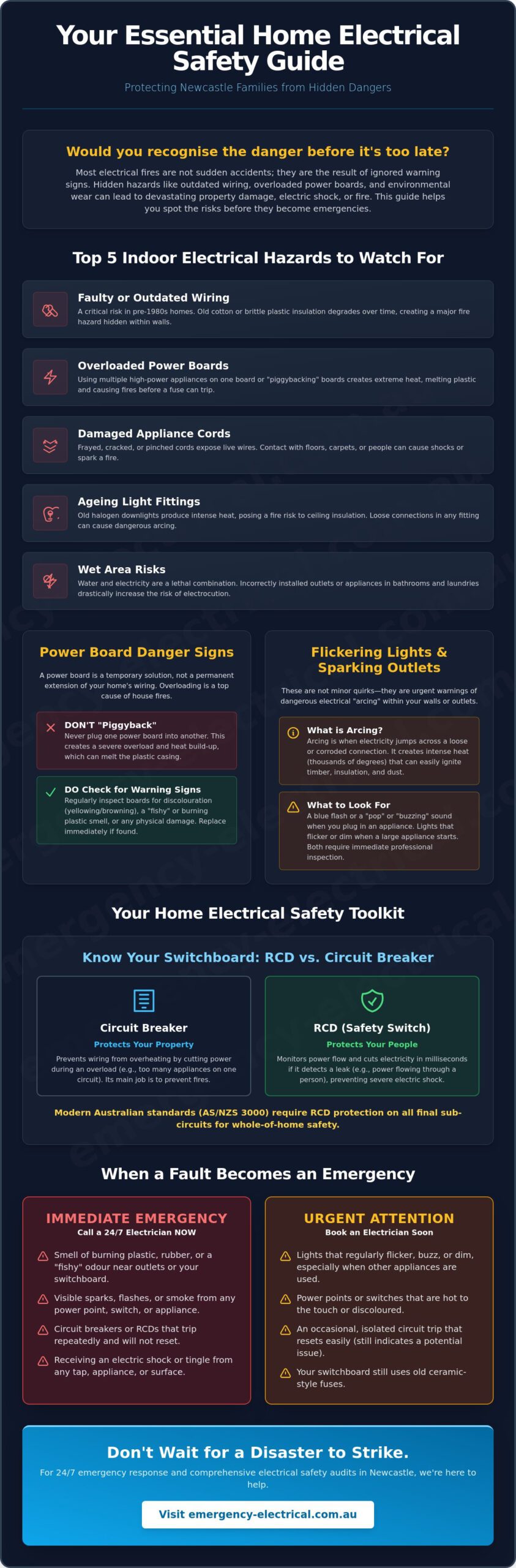
Top 5 Indoor Electrical Hazards to Watch Out For
Internal environments present unique risks that differ from the external infrastructure discussed earlier. While the bones of your house provide shelter, the internal wiring and appliances you use daily are the most frequent points of failure. Identifying the specific electrical safety hazards home occupants encounter is the only way to prevent avoidable accidents. From the kitchen to the bedroom, these five hazards are the most common culprits behind domestic electrical fires and shocks in Australia.
- Faulty or outdated wiring: This is a significant concern for pre-1980s Newcastle homes that may still rely on cotton-braided or early plastic insulation that has become brittle.
- Overloaded power boards: Using multiple high-wattage appliances on a single board creates a dangerous thermal load.
- Damaged appliance cords: Frayed leads or exposed copper wiring can easily spark against floor coverings.
- Aging light fittings: Older halogen downlights or loose sockets generate excessive heat and are prone to short-circuiting.
- Wet area risks: Electricity in bathrooms and laundries requires strict adherence to safety zones to prevent lethal shocks.
The Danger of Overloaded Power Boards
A power board is a temporary solution, not a permanent fixture. Daisy-chaining multiple boards together, often called “piggybacking”, causes significant heat build-up within the internal copper tracks. This can lead to the plastic casing melting or combusting before your switchboard even detects a fault. You should regularly check your boards for signs of stress. Discolouration around the socket or a faint, “fishy” smell are clear indicators that the plastic insulation is overheating and requires immediate replacement.
Flickering Lights and Sparking Outlets
Flickering lights are rarely just a sign of a loose bulb. They often indicate loose terminal connections in the ceiling or “arcing” behind your walls. Arcing occurs when electricity jumps across a gap in a connection, creating intense heat that can ignite nearby timber or insulation. If you see a blue flash or hear a “pop” when plugging in an appliance, the outlet’s internal contacts have likely failed. When these symptoms appear, contacting an emergency electrician Newcastle families can rely on is vital to catch the problem before it becomes a fire.
According to safety experts, many Common Electrical Hazards stem from simple neglect or a lack of regular maintenance. Ensuring your indoor fittings are in good condition is a small task that offers massive peace of mind. A quick professional electrical inspection is often all it takes to confirm your home’s interior is safe for your family.
Outdoor Electrical Dangers: From Private Poles to Storm Damage
Outdoor areas introduce environmental variables that internal systems rarely encounter. While we have already discussed the risks hidden behind your plasterboard, the external infrastructure connecting your property to the grid is just as critical. Low-hanging or frayed overhead service lines are significant electrical safety hazards home owners must monitor, especially after periods of high wind or heavy rain. In the Hunter region, many properties rely on private power poles to bridge the gap between the street and the house. It’s a common misconception that the utility provider maintains these; in reality, the structural integrity and electrical safety of a private pole are the homeowner’s legal responsibility.
Water ingress remains a constant threat to outdoor power points and garden lighting. Even weather-rated outlets can degrade over time, leading to short circuits that trip your safety switches. Perhaps the most alarming outdoor hazard is feeling a “tingle” when touching a metal tap or a garden hose connection. This sensation often indicates a neutral fault in your grounding system. If this happens, it is a major emergency. It means your house may be using the plumbing as a return path for electricity. Following basic home electrical safety principles is essential, but these structural grid issues require a specialised approach to resolve.
Newcastle Storms and Your Grid Connection
Severe Newcastle storms often bring lightning strikes and fallen branches that impact your point of attachment. If your service lines are sagging or the bracket has pulled away from the fascia, you require ASP Level 2 Electrical Work. Standard electricians are not authorised to work on the grid-side of your meter. After a severe Hunter storm, stay at least eight metres away from any downed lines and look for visible damage to your connection points before touching any external metal fixtures.
Salt Air and Corrosion on the Coast
Living in coastal suburbs like Port Stephens or Merewether comes with the unique challenge of salt air. Salt spray accelerates rust and corrosion at an incredible rate, often eating through protective coatings in just a few seasons. We frequently find corroded meter boxes that have become structurally unsound, allowing moisture to reach live terminals and causing electrical instability. Regular inspections are vital for coastal properties to ensure that salt hasn’t compromised your main switchboard or external isolating links.
Your Home Electrical Safety Toolkit: RCDs and Inspections
Building a resilient electrical system requires more than just a cautious eye; it requires the right hardware. While we’ve covered the most common electrical safety hazards home owners face, the first line of defence is always your switchboard. Understanding the difference between a circuit breaker and a Residual Current Device (RCD) is fundamental to your family’s safety. A circuit breaker is designed to protect your house’s wiring from overheating and causing a fire due to an overload. In contrast, an RCD, commonly known as a safety switch, is designed to protect human life. It monitors the flow of electricity and cuts the power in milliseconds if it detects current leaking to earth, which often happens during an electric shock.
Understanding Safety Switches (RCDs)
An RCD detects a leakage of current in milliseconds, reacting far faster than any human reflex. In New South Wales, an RCD is legally required for all power and light circuits to meet modern safety standards. You might occasionally experience “nuisance tripping”, where the switch flips for no apparent reason. This is often caused by a faulty old appliance, like a leaky kettle or a dusty power tool, rather than a major fault in the house wiring. However, you should never ignore a trip. If your safety switch won’t reset, it’s a clear sign that a genuine hazard exists and requires professional attention.
To ensure these devices remain functional, you should follow the “Push to Test” rule. Every modern RCD has a small button, usually marked with a ‘T’. We recommend pressing this button once a month. It should immediately trip the switch and cut power to that specific circuit. If it doesn’t trip, the internal mechanism is likely seized or faulty. This means it won’t protect you in a real emergency, leaving your family vulnerable to shocks.
The Value of a Professional Safety Audit
While monthly testing is a great start, DIY checks are never a substitute for a comprehensive professional report. During a safety audit, a licensed sparky uses specialised tools like infrared thermal imaging to find “hot spots” behind walls that are invisible to the naked eye. We also verify the integrity of your home’s earthing system. This ensures that any fault current has a safe path to the ground stake rather than passing through a person. If you haven’t had your switchboard looked at in the last few years, it’s time to book a General Electrical and Maintenance Service to confirm your safety toolkit is actually working.
Protecting Your Newcastle Home: When a Fault Becomes an Emergency
Knowing when to act is the final piece of the safety puzzle. Managing the electrical safety hazards home systems develop over time requires a balanced approach of vigilance and professional support. While some issues like a flickering bulb might wait until Monday morning, others demand an immediate response to prevent a house fire or a lethal shock. If you suspect a major hazard, your priority is safety. If it’s safe to do so, locate your main switchboard and turn off the “Main Switch” to isolate the entire property. Avoid touching any metal fixtures or appliances if you’ve felt a tingle or see smoke. Once the power is isolated, don’t attempt to investigate the fault yourself; wait for a licensed professional to declare the site safe.
Shifting from reactive to proactive safety is the best way to protect your family. Rather than waiting for a component to fail, regular check-ups allow you to identify degraded insulation or corroded terminals before they spark. This is especially important for those living in coastal areas where salt air accelerates the breakdown of your grid connection. Newcastle Emergency Electrical plays a vital role in this process, providing the community with seasoned experts who understand the unique infrastructure of the Hunter region.
Immediate Red Flags: When to Call 24/7
Some symptoms indicate that your electrical system is in a state of active failure. If you notice any of the following, you require an immediate 24/7 emergency response:
- Burning smells or smoke: This often starts as a “fishy” or acrid plastic scent coming from outlets or the switchboard.
- Loud buzzing or crackling: These sounds indicate active arcing, where electricity is jumping between loose connections.
- Electric shocks or tingles: Any sensation from a metal tap, appliance casing, or showerhead is a major neutral fault emergency.
- Loss of essential power: A sudden failure of medical equipment or your hot water system requires rapid intervention to restore safety and comfort.
Why Choose Newcastle Emergency Electrical?
We provide unwavering availability across Maitland, Lake Macquarie, and Newcastle. Our team doesn’t just handle general repairs; we specialise in complex fault diagnosis and ASP Level 2 Electrical Work. This means we can manage everything from a tripped safety switch inside your kitchen to a damaged service line on your private power pole. Our commitment to high-quality Australian workmanship ensures that every repair meets the latest AS/NZS 3000 standards, giving you long-term peace of mind. We pride ourselves on being a steady guardian of safety for our neighbours, combining technical authority with the approachability of a local service provider. Don’t leave your property’s safety to chance; contact Newcastle Emergency Electrical for a safety inspection today to ensure your home remains a secure sanctuary.
Secure Your Home and Family Against Electrical Risks
You now have the knowledge to identify the most critical electrical safety hazards home systems develop, from the subtle “fishy” smell of an overheating power board to the dangerous tingles of a coastal neutral fault. While regular monthly RCD testing is an excellent habit for every Newcastle household, the complexities of ageing terrace wiring and storm-damaged service lines require a specialised eye. Maintaining your property’s electrical integrity isn’t just about compliance; it’s about the ongoing protection of your family and your investment.
Our team of licensed ASP Level 2 electricians has been serving the Newcastle and Hunter Region for years, providing a reliable 24/7 emergency response to keep our community safe. We understand the unique challenges of our local environment, from salt air corrosion to the structural demands of private power poles. Don’t leave your safety to chance or wait for a minor fault to escalate into a crisis. Book a Comprehensive Electrical Safety Audit for Your Home today to ensure your switchboard and grid connection are fully protected. Taking these proactive steps now provides the peace of mind that your home remains a secure sanctuary for years to come.
Frequently Asked Questions
What are the 3 most common electrical hazards in a home?
The three most frequent electrical safety hazards home owners encounter are faulty wiring, overloaded power boards, and outdated switchboard protection. Ageing insulation in older Newcastle homes often leads to short circuits, while “piggybacking” multiple adapters creates excessive heat build-up. Without functional RCDs, these common issues can quickly escalate into house fires or dangerous shocks that your system cannot automatically stop.
Is a flickering light a fire hazard?
Yes, a flickering light is frequently a symptom of loose terminal connections or “arcing” behind your walls. Arcing occurs when electricity jumps across a gap, creating intense heat that can ignite nearby timber or insulation before you even notice a problem. If replacing the bulb doesn’t fix the issue, you should treat it as a potential fire risk and have a professional investigate the circuit immediately.
Can I change a light switch or power point myself in NSW?
No, it is illegal for unlicensed individuals to perform any electrical work in NSW, including changing light switches or power points. All electrical work must be carried out by a licensed electrician who can provide a Certificate of Compliance for Electrical Work (CCEW). From 1 July 2026, these certificates must be lodged through the BCNSW eCert portal to ensure the work meets Australian safety standards.
Why do I get a tingle when I touch my metal taps?
Feeling a tingle from metal taps is a major emergency caused by a neutral fault in your grounding system. This indicates that electricity is using your plumbing as a return path because the main earth connection has failed or been compromised. You should stop using the water immediately, avoid touching any metal fixtures, and call an emergency electrician to prevent a potentially lethal shock.
What is the difference between a safety switch and a circuit breaker?
A safety switch (RCD) is designed to protect people from electrocution, while a circuit breaker is designed to protect your home’s wiring from overloading. An RCD cuts power in milliseconds if it detects current leaking to earth. A circuit breaker only trips when the current flow exceeds the wire’s capacity, which prevents the cables from melting and starting a fire but won’t necessarily stop a shock.
How often should I have an electrical safety inspection in Newcastle?
You should generally have a professional safety inspection every two years, though older Newcastle terraces or coastal properties require more frequent checks. Salt air accelerates corrosion on external fittings, making regular audits vital for maintaining stability. Pre-sale condition reports or inspections after major Hunter storms are also highly recommended to ensure your system continues to meet the latest AS/NZS 3000 wiring rules.
What should I do if I smell something burning but cannot find the source?
If you smell a “fishy” or burning plastic scent, you should immediately turn off the main power switch at your switchboard. This scent often indicates that insulation is melting inside a wall cavity or an outlet you can’t see. Once the power is isolated, contact a 24/7 emergency service to locate the fault, as the source is likely hidden behind your plasterboard or in the ceiling.
Are old ceramic fuses still safe to use in 2026?
No, ceramic fuses are considered outdated and unsafe by modern standards in 2026. They don’t provide the rapid protection required for modern high-draw appliances and lack the life-saving capabilities of RCDs. Many Australian insurance providers are now refusing to renew policies for homes that still rely on ceramic fuses, making a switchboard upgrade a financial necessity as well as a safety priority.