
That weathered timber pole standing on your property isn’t just a piece of infrastructure; it’s a legal responsibility that rests entirely on your shoulders. Many Hunter property owners are surprised to learn that Ausgrid or Essential Energy isn’t responsible for the poles located beyond the initial connection point. If you’ve recently received a defect notice or worry about falling lines during a bushfire season, the pressure to organise a private power pole replacement can feel overwhelming.
We understand that dealing with high-voltage equipment is daunting, especially when safety and compliance are at stake. This guide provides everything you need to know to secure your property and maintain a reliable connection. We’ll explain how to identify structural issues like rot or rust, the specific requirements for Level 2 ASP electricians in New South Wales, and the steps involved in upgrading to a durable steel or composite pole to keep your home protected.
Key Takeaways
- Learn how to identify the legal boundary of your electrical connection to confirm your maintenance responsibilities.
- Spot early warning signs of failure, such as fungal rot or ground instability, before they lead to dangerous fallen lines.
- Compare the durability and maintenance needs of different materials to choose the best option for your private power pole replacement.
- Understand the mandatory role of a Level 2 ASP electrician in managing high-risk grid connections and safety compliance.
- Get a clear overview of the coordination required with local network providers to ensure a seamless and safe installation.
Understanding Your Responsibility for Private Power Poles
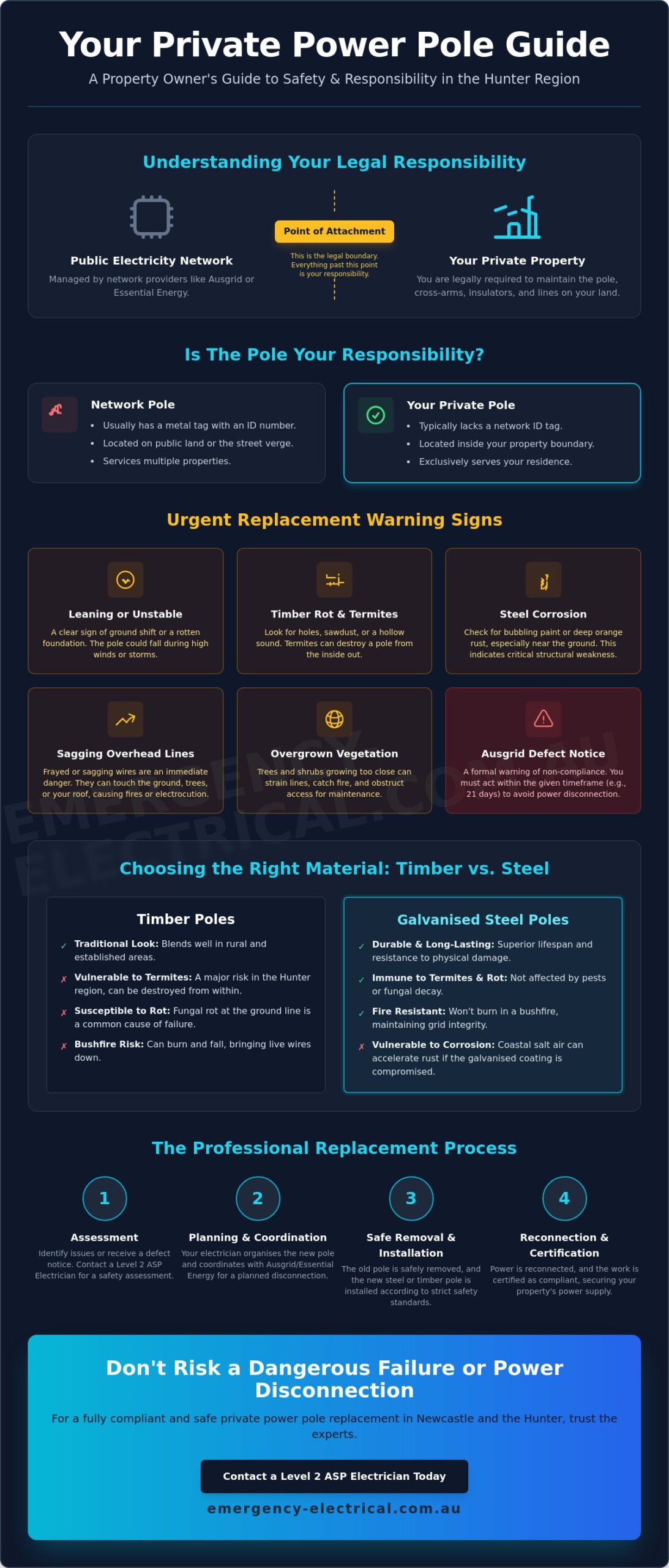
In the Hunter region, many residents believe that Ausgrid or Essential Energy manages every piece of electrical hardware on their street. This is a common misconception that often leads to safety risks and unexpected costs. A private power pole, also known as a property pole, is any pole located on your land that supports the lines connecting your home to the main grid. The legal boundary for responsibility is the Point of Attachment. This is the exact spot where the network provider’s wires connect to your property’s infrastructure. Once the power passes this point, the maintenance and eventual requirement for a private power pole replacement become your legal duty.
Homeowners in Newcastle and Maitland often face these responsibilities due to the prevalence of overhead power connections in established suburbs. Unlike underground connections where the network provider typically maintains the line to the meter box, overhead systems require a clear physical support structure. If that structure sits on your land, it belongs to you. This ownership includes the pole itself, the cross-arms, and the insulators that keep the lines secure. Understanding this distinction is the first step in ensuring your home remains safe and compliant with state regulations.
How to Identify a Private Power Pole
Identifying ownership is usually straightforward if you know what to look for. Network poles almost always feature a metal tag with a unique identification number. If the pole on your property lacks these markings, it’s likely your responsibility. Physical location is another clear indicator. Poles situated inside your boundary that exclusively serve your residence are private. Property owners should specifically look for the “first pole” that receives the overhead service line from the street. Understanding the basics of utility pole materials and function is useful here. It helps you distinguish between public infrastructure and your private assets that require regular safety checks.
The Legal Obligations for NSW Property Owners
Under the NSW Electricity Supply Act, property owners are legally required to ensure their electrical installations are safe and well-maintained. This isn’t just a suggestion; it’s a mandatory safety standard designed to prevent bushfires and electrical accidents. If a neglected pole falls or causes a fire, the property owner may be held liable for damages and could face significant fines. You’re also responsible for keeping the area around the pole clear of vegetation. Overgrown trees can strain lines or catch fire during a surge, making regular inspections a vital part of property management. If your pole shows signs of age or damage, delaying a private power pole replacement could lead to a mandatory defect notice from your network provider and a sudden disconnection of your power supply.
Warning Signs Your Private Power Pole Needs Urgent Replacement
Early detection is the best way to avoid a total system failure or a hazardous electrical fire. While some issues are obvious, others require a closer look at the base of the structure. If you notice your pole leaning at an angle, it’s often a sign that the ground has shifted or the foundation has rotted away. Timber poles are particularly susceptible to fungal rot and termite infestations. Look for small holes, sawdust-like deposits, or a hollow sound when tapped. For galvanised steel poles, check the ground line for bubbling paint or deep orange rust. This indicates the metal is losing its structural integrity and may snap during high winds. Don’t ignore frayed or sagging overhead lines either. These are immediate hazards that require a private power pole replacement to prevent live wires from touching the ground.
Common Causes of Pole Failure in the Hunter Region
The Hunter region presents unique environmental challenges that shorten the lifespan of electrical infrastructure. Properties in Newcastle and Port Stephens deal with coastal salt air. This salt significantly accelerates corrosion in metal components and steel poles. In rural areas like Maitland and Lake Macquarie, high termite pressure can destroy a timber pole from the inside out. Additionally, heavy storm seasons in the Hunter Valley often lead to soil erosion. This movement causes poles to shift or sag under the weight of the overhead lines, making them unstable and dangerous.
What to Do If You Receive an Ausgrid Defect Notice
Receiving an Ausgrid defect notice is a formal warning that your infrastructure doesn’t meet safety standards. You’ll typically have a set timeframe, often 21 to 30 days, to address the issue before your power is disconnected. This isn’t just a suggestion; it’s a critical safety requirement. Ignoring the notice increases the risk of fire and leaves you liable for any damage caused by falling lines. To clear the notice and ensure your home stays connected, you’ll need to contact a Level 2 electrician Newcastle. They can certify the work and notify the network provider that the defect has been rectified. Acting quickly ensures your service remains active and your property stays safe.
If you’ve spotted any of these warning signs, a professional assessment is the safest next step. Our experienced team can help you determine if a private power pole replacement is the right solution for your property.
Choosing the Right Material: Timber vs. Galvanised Steel Poles
Selecting the right material for your private power pole replacement is a decision that affects your property’s safety and your wallet for decades. In the Hunter region, your choice often depends on whether you’re managing a suburban block in Newcastle or a sprawling property in the Hunter Valley. Each material reacts differently to our local humidity, soil types, and pest pressures. While initial costs vary, you should weigh the upfront investment against the expected lifespan and the amount of maintenance required over the next twenty years. A pole that looks sturdy today might succumb to the elements sooner than expected if it isn’t suited to your specific environment.
Aesthetics also play a significant role in residential areas. A sleek, modern pole might suit a contemporary home in Port Stephens, while a traditional timber pole feels more at home on a rural Maitland acreage. Beyond looks, the structural integrity of the material determines how well it will withstand the heavy storm seasons we often experience. Understanding the trade-offs between hardwood and steel ensures you won’t be facing another replacement sooner than necessary.
Hardwood Timber Poles: The Traditional Choice
Treated hardwood has been the standard for decades across New South Wales. These poles are naturally strong and non-conductive; this provides an extra layer of safety during certain types of electrical faults. In rural areas like the Hunter Valley, timber is often the preferred choice because it blends into the natural landscape. However, timber isn’t invincible. It’s highly susceptible to ground rot and termite activity, which are prevalent in our warmer, humid climate. Industry data suggests a treated hardwood pole typically lasts between 15 and 30 years. If you choose timber, you’ll need to commit to regular ground-line inspections to ensure the base hasn’t been hollowed out by pests or fungal decay.
Galvanised Steel Poles: Modern Durability
If you’re looking for a slimmer, more modern profile, galvanised steel is an excellent alternative. These poles are completely termite-proof and offer superior fire resistance. This is a significant advantage in bushfire-prone parts of the Hunter region. They are particularly popular in residential Newcastle and Port Stephens suburbs where space is limited and a smaller footprint is desired. Despite their strength, steel poles often have a shorter expected lifespan of 10 to 20 years compared to hardwood. The primary enemy here is corrosion. In high-salinity coastal areas, salt air can lead to rust at the ground line. To get the most out of a steel pole, it must be properly galvanised and inspected regularly for signs of bubbling or flaking metal. For many property owners, the lack of termite risk makes steel the more reassuring choice for a private power pole replacement.
The Replacement Process: Why You Need a Level 2 ASP Electrician
Executing a private power pole replacement is a complex technical operation that goes far beyond simple construction. It requires a precise sequence of events to ensure the safety of your property and the stability of the local electrical grid. The process begins with a professional site assessment. We use specialised equipment to locate underground services, ensuring that excavation doesn’t disturb existing water, gas, or data lines. Once the site is cleared, we coordinate directly with network providers like Ausgrid or Endeavour Energy to schedule a safe power disconnection. This coordination is vital; work cannot commence while the service lines are live.
After the power is isolated, the physical work begins. The old, compromised pole is carefully removed, and a new footing is excavated to meet strict depth and stability requirements. Once the new pole is positioned and secured, we re-attach the service lines and ensure the Point of Attachment is at the legally required height. The final stage involves rigorous testing of the entire connection. We then submit a Notice of Service Work (NOSW) to the relevant authorities. This document is your official record that the installation meets all NSW safety standards and regulatory requirements.
What is an ASP Level 2 Electrician?
In New South Wales, the distinction between a standard electrician and an Authorised Service Provider (ASP) is critical. While a typical “sparky” is qualified for internal house wiring, only a Level 2 ASP is legally authorised to perform work on the service lines that connect a property to the street’s electricity network. This accreditation involves advanced training in high-risk environments and live power handling. For any private power pole replacement, a Level 2 qualification is mandatory. Choosing a local expert who understands the specific Hunter network standards ensures your installation is compliant and avoids the risk of future defect notices.
Safety Protocols During Replacement
Safety is the primary driver behind every step of the replacement process. Managing live power risks requires specialised gear and strict adherence to exclusion zones to protect your family and our crew. We also handle the responsible disposal of your old infrastructure. Many older timber poles were treated with chemicals like creosote, making them hazardous waste that cannot be simply discarded in a standard skip. Our team ensures the new connection meets NSW height regulations to prevent low-hanging wires that could be struck by vehicles or machinery. Correct installation at the Point of Attachment is a key factor in passing the final inspection.
If you have received a defect notice or have concerns about the stability of your connection, our team is ready to help. Contact us for professional ASP Level 2 electrical work to ensure your replacement is handled with the highest standards of safety and expertise.
Professional Private Pole Services in Newcastle and the Hunter
Newcastle Emergency Electrical brings years of specialised experience to every Level 2 grid connection we handle. We understand the specific challenges of the Hunter landscape, from the shifting clay soils in Maitland to the corrosive salt air along the Port Stephens coast. This local insight allows us to recommend the most durable materials and installation methods for your specific location. Whether you’re dealing with a sudden emergency or planning a long-term upgrade, our team provides a seamless transition from the initial assessment to the final certification of your property’s electrical infrastructure.
Storms and accidents don’t wait for business hours. Our rapid response team is available to secure your property when a private power pole replacement becomes an urgent safety matter. We manage the entire process, including the complex coordination required to resolve Ausgrid or Essential Energy defect notices. You won’t have to worry about chasing different contractors or navigating network provider bureaucracy; we handle the technical work and the paperwork from start to finish. Our goal is to restore your peace of mind as quickly as we restore your power.
Our Commitment to Safety and Compliance
We take our role as your local safety guardians seriously. Our team is fully insured and ASP Level 2 accredited; this ensures every job meets the highest industry standards and legal requirements in New South Wales. We believe in transparent communication, so you’ll always know exactly what’s happening with your connection and what the final results will be. By managing all coordination and technical submissions with the network provider, we remove the stress of compliance. You can trust that your new infrastructure is safe, durable, and fully authorised.
Get a Professional Assessment Today
Don’t wait for a leaning pole or a defect notice to take action. Proactive maintenance is the most effective way to avoid the high costs and safety risks of a sudden failure. We provide expert safety inspections across Newcastle, Lake Macquarie, Maitland, and Port Stephens to identify potential issues before they escalate into dangerous situations. A small investment in a professional inspection today can save you from a major electrical crisis tomorrow. Contact our Level 2 team for an expert pole assessment and secure your property’s private power pole replacement with the Hunter’s trusted specialists.
Secure Your Property with a Compliant Connection
Maintaining the electrical infrastructure on your land is more than just a regulatory hurdle; it’s a vital part of property safety. By identifying the warning signs of decay and understanding your legal obligations at the Point of Attachment, you can prevent dangerous outages and costly defect notices. Whether you choose the traditional strength of timber or the modern durability of galvanised steel, a professional private power pole replacement ensures your home stays connected and compliant for decades to come.
Don’t leave your safety to chance or wait for a storm to expose a hidden weakness. As an ASP Level 2 Authorised specialist and a local Newcastle family-owned business, we provide the expertise needed to manage high-risk grid connections safely. We offer 24/7 emergency response across the Hunter to ensure you’re never left in the dark during a crisis. Our team understands the local landscape and the specific requirements of our regional network providers.
Book a Level 2 Inspection for Your Private Power Pole today to gain total peace of mind. We’re ready to help you navigate the technical requirements and deliver a reliable, long-term solution for your property.
Frequently Asked Questions
Who is responsible for the power pole on my property in NSW?
Property owners are legally responsible for all electrical infrastructure on their land beyond the network connection point. This includes the pole, cross-arms, and wires leading directly to your home. Under the NSW Electricity Supply Act, you must maintain these assets to prevent safety hazards like bushfires or falling lines. If the pole is located within your boundary and serves only your residence, it’s your duty to keep it safe.
How much does it cost to replace a private power pole in Newcastle?
The total investment for a private power pole replacement depends on several factors, including the chosen material and the ease of site access. Prices vary significantly between timber, steel, and composite options. Because every property in the Hunter has unique soil conditions and connection requirements, you should obtain a detailed quote from a qualified Level 2 ASP to get an accurate figure for your specific situation.
What happens if I ignore an Ausgrid defect notice for my power pole?
Ignoring a defect notice typically leads to a mandatory disconnection of your power supply by the network provider. Beyond losing electricity, you face potential fines and significant legal liability if the faulty pole causes a fire or injury to others. Network providers usually allow a specific timeframe, often between 21 and 30 days, to complete repairs before they take action to isolate the service.
How long does a private power pole replacement take?
Most physical installations are completed within a single day to minimise disruption to your power supply. However, the entire process requires advance coordination with Ausgrid or Essential Energy to schedule the necessary disconnection and reconnection. A professional team manages these logistics well in advance to ensure the site is ready for a swift and safe transition on the day of the work.
Can I replace a timber power pole with a steel one?
You can certainly upgrade from a timber pole to a galvanised steel one during the private power pole replacement process. Many homeowners prefer steel because it’s immune to termites and offers better fire resistance in high-risk areas. Your electrician will ensure the new steel structure meets all current NSW Service and Installation Rules, providing a slimmer profile that often looks more modern in suburban streets.
Do I need a Level 2 electrician for a private pole replacement?
A Level 2 Accredited Service Provider (ASP) is legally required for any work involving the connection between your property and the street’s power lines. Standard electricians don’t have the authorisation or specialised training to handle live grid connections or the installation of service equipment. Using an ASP Level 2 ensures your installation is certified, compliant with state safety regulations, and properly recorded with the network provider.
What is the life expectancy of a galvanised steel power pole?
Galvanised steel poles generally have a life expectancy of 10 to 20 years in standard conditions. This lifespan can be shorter in coastal suburbs like Port Stephens or Merewether due to the corrosive effects of salt air on metal. Regular inspections at the ground line are essential to spot early signs of rust or bubbling metal, which can compromise the pole’s structural integrity over time.
Is my private power pole covered by home insurance?
Most standard home insurance policies don’t cover power poles for general wear, rot, or termite damage. Coverage is typically limited to sudden, accidental events such as a vehicle impact or a severe storm that causes immediate damage. It’s best to review your Product Disclosure Statement (PDS) or speak with your insurer to understand exactly what is protected under your specific policy before an issue arises.